
Supreme Court Keeps Aravalli Mining Definition and Directions in Abeyance, Constitutes High-Powered Expert Committee
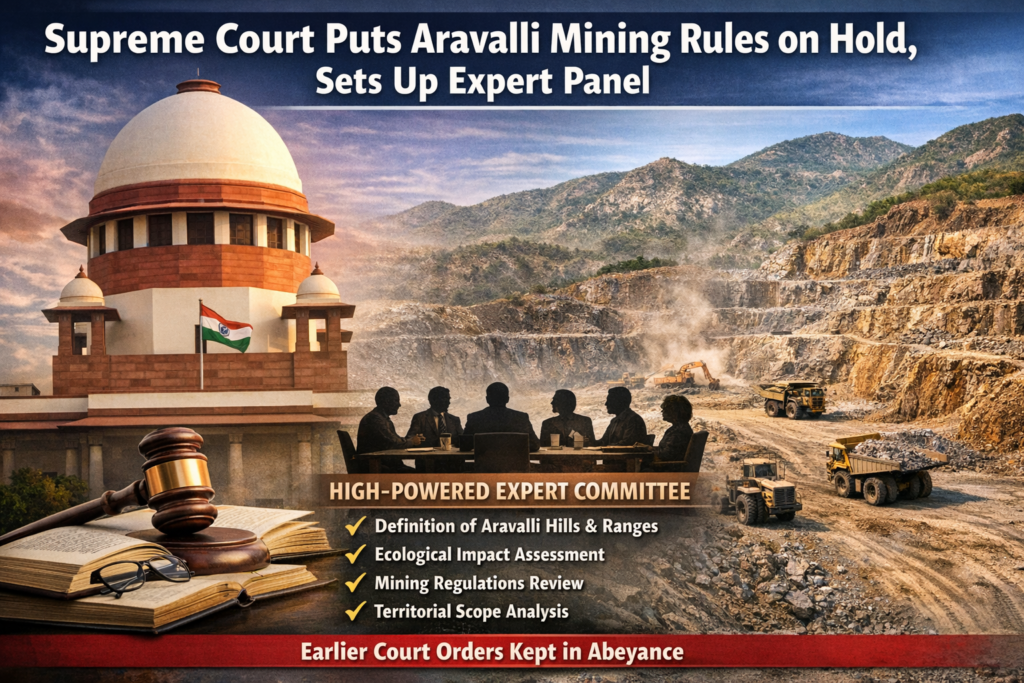
The Supreme Court of India, by an order dated 29 December 2025, has kept in abeyance its earlier judgment dated 20 November 2025 concerning the definition of the Aravalli Hills and Ranges and the regulatory framework governing mining activities in the region, pending further examination by a High-Powered Expert Committee.
The proceedings arise out of a suo motu writ petition initiated by the Court on issues relating to the definition, demarcation, and protection of the Aravalli Hills and Ranges, often described as the ecological backbone of north-western India. The Court noted that the Aravallis serve as a critical geographical barrier between the arid desert regions and the fertile northern plains, and that the range has faced sustained anthropogenic pressures including urbanisation, deforestation, and mining.
The Court recalled that since 2002 it has been seized of matters relating to mining in the Aravalli region. In view of divergent definitions adopted by different States—Delhi, Rajasthan, Haryana, and Gujarat—the Court, by an order dated 9 May 2024, had directed the constitution of a Committee to frame a uniform definition of the Aravalli Hills and Ranges. The Committee submitted its report on 3 October 2025, proposing an operational definition based on elevation, local relief, and proximity between hill formations.
Relying on this report, the Court, in its judgment dated 20 November 2025, accepted the Committee’s recommendations, including the proposed definition, prohibition of mining in core and inviolate areas, and a direction that no new mining leases be granted until a comprehensive mining plan was prepared. Existing mining operations were permitted to continue subject to strict compliance with the Committee’s recommendations.
Subsequently, several interlocutory and miscellaneous applications were filed challenging the Committee’s findings and seeking clarification of the Court’s directions. The Court observed that there had also been significant public criticism and concern from environmental groups, primarily on account of perceived ambiguities in the definition and the possibility of its misinterpretation during implementation.
Taking note of these concerns, the Court held that certain critical issues required further clarification, including whether the 500-metre proximity criterion could narrow the scope of protection, whether ecologically contiguous areas might be excluded from regulation, and whether the elevation-based threshold could result in large portions of the Aravalli range losing environmental protection. The Court also noted public claims that only a small fraction of hills in Rajasthan might qualify under the adopted criteria, raising the possibility of a regulatory gap.
In view of these issues, the Court proposed the constitution of a High-Powered Expert Committee comprising domain experts to conduct a comprehensive assessment of the earlier Committee’s report. The expert body has been tasked with examining the precise territorial impact of the definition, identifying areas included and excluded, assessing ecological consequences of regulated mining, and evaluating short- and long-term environmental impacts.
The Court issued notice to the Union of India and the Governments of Delhi, Rajasthan, Haryana, and Gujarat, and directed that the matter be listed before the Green Bench on 21 January 2026. The Attorney General, the Solicitor General, and the Amicus Curiae were requested to assist the Court along with the Central Empowered Committee.
Importantly, the Court directed that, until further orders, the recommendations of the earlier Committee and the directions issued in the judgment dated 20 November 2025 shall remain in abeyance, so as to prevent any irreversible administrative or ecological consequences. The Court further reiterated that no permission shall be granted for new or renewed mining leases in the Aravalli Hills and Ranges, as defined in the Forest Survey of India report dated 25 August 2010, without prior permission of the Court.